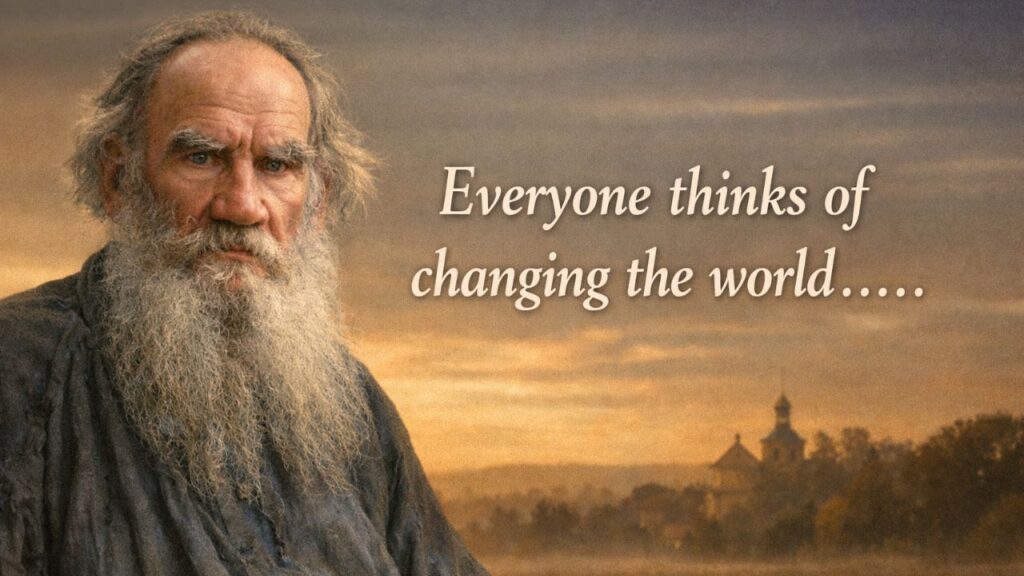
The world often talks about reform, progress and justice, yet many people hesitate to reflect on their own actions. This timeless thought by Leo Tolstoy gently reminds us that true change begins with personal honesty and moral courage.
Tolstoy’s words feel even more important today when opinions are loud, but self-reflection is rare. Instead of only pointing out what is wrong around us, he encourages each person to look inward first.
By asking us to improve ourselves before attempting to change society, Tolstoy presents a simple idea with powerful depth. His insight invites patience, humility and responsibility in everyday life.
Understanding the Heart of the Quote
The Real Meaning Behind Tolstoy’s Message
Tolstoy’s quote highlights a strong truth about human behaviour. People are quick to criticise systems, governments and society, but they rarely examine their own character. He believed that real change begins when individuals develop honesty, discipline and compassion. Without inner growth, even the biggest reforms lose meaning.
A Call for Self-Reflection and Honesty
This thought does not dismiss social reform. Instead, it explains that lasting change becomes possible only when people improve themselves. Tolstoy reminds us that self-correction requires courage. When individuals choose fairness, kindness and responsibility, they naturally help build a better world.
Leo Tolstoy: A Life That Shaped His Philosophy
Privileged Beginnings and Inner Conflict
Leo Tolstoy was born in 1828 into Russian aristocracy. Though he enjoyed comfort and education, he felt constant inner conflict. He questioned whether luxury and social position truly created purpose. This struggle shaped his lifelong search for moral truth.
War Experiences That Changed His View
His time as a soldier transformed his thinking. Witnessing pain, death and injustice forced him to rethink life, humanity and morality. These experiences later influenced his writing style, making his works emotionally real and deeply reflective.
How His Life Inspired His Greatest Works
War and Peace: More Than a Historical Novel
War and Peace is not simply a story about battles. It studies destiny, leadership, family bonds and moral choices. Through complex characters, Tolstoy shows how individuals balance duty, fear, love and conscience while facing powerful historical events.
Anna Karenina: A Study of Human Emotion and Responsibility
In Anna Karenina, Tolstoy explores love, emotional struggle and social expectations. Anna’s tragic path highlights the consequences of ignoring inner moral guidance. The novel also contrasts different relationships to show how choices shape happiness, pain and destiny.
A Turn Toward Spiritual and Moral Awakening
A Personal Crisis That Changed Everything
Later in life, Tolstoy faced a deep spiritual crisis. Fame and wealth no longer satisfied him. He began questioning purpose, morality and the value of material success. This transformation shifted his focus toward philosophy and ethical living.
A Simpler Life and Stronger Values
Tolstoy eventually embraced simplicity, nonviolence and compassion. He promoted self-awareness, moral discipline and peaceful resistance to injustice. His principles inspired many great leaders, including Mahatma Gandhi, who admired his commitment to truth and humanity.
Art, Morality and the Power of Inner Change
Tolstoy’s greatness lies in the way he blended storytelling with moral understanding. His works do not preach, but they gently encourage readers to question their actions and values. He believed that strong societies begin with strong individuals. The quote of the day beautifully represents his belief that personal improvement is the strongest foundation for meaningful change.
Other Timeless Thoughts by Tolstoy
- “If you want to be happy, be.”
- “All happy families resemble one another, each unhappy family is unhappy in its own way.”
- “The two most powerful warriors are patience and time.”
- “Respect was invented to cover the empty place where love should be.”
Each of these reflections shows Tolstoy’s deep understanding of human emotions, honesty and inner strength.
Why Tolstoy’s Message Still Matters Today
Even though Tolstoy passed away in 1910, his wisdom remains powerful. Modern life is busy and uncertain, but his words bring clarity. They remind us that speeches, systems and protests alone cannot change the world unless individuals first change themselves.
Tolstoy’s quote, “Everyone thinks of changing the world, but no one thinks of changing himself,” continues to inspire people across generations, teaching that the strongest path to a better world always begins with a better self.