The universe is constantly changing, even though it may look calm from Earth. Planets move, stars age, and massive objects travel silently through space. Scientists use long-term observations and precise calculations to predict certain astronomical events that may occur within a human lifetime.
Some of these events are slow and predictable, such as the return of famous comets or close approaches of known asteroids. Others involve dramatic changes, including sudden star explosions or rare planetary alignments. These events are not guesses but are based on measurable data collected over decades.
This article explains six astronomical events that scientists say could realistically happen within our lifetimes. Each event is described using confirmed scientific information, focusing on what will happen, when it may occur, and why it is important for astronomy.
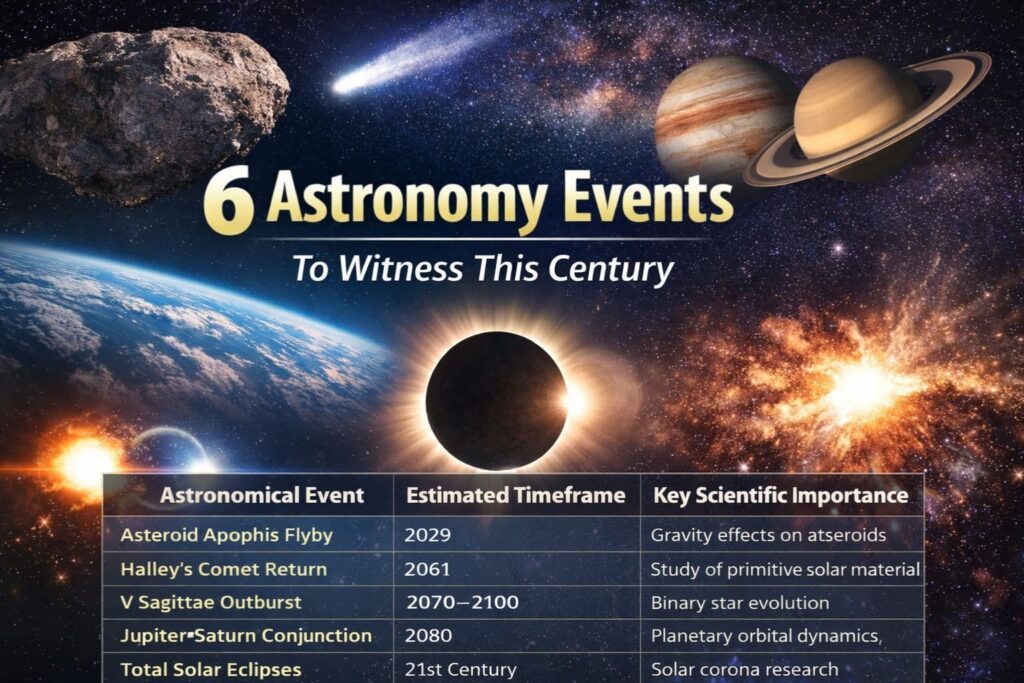
1. The Close Flyby of Asteroid 99942 Apophis (2029)
Asteroid 99942 Apophis was discovered in 2004 and immediately attracted attention because of its size and orbit. It measures approximately 370 to 450 meters in diameter and follows a path that brings it close to Earth on a regular cycle. Early observations raised impact concerns, but later calculations ruled out any collision for at least the next century.
On April 13, 2029, Apophis will pass extremely close to Earth at a distance of roughly 32,000 to 38,000 kilometers. This is closer than many geostationary satellites that orbit the planet. Such a close approach by an object of this size is rare and scientifically valuable.
During the flyby, Earth’s gravity will slightly alter Apophis’s orbit and rotation. Scientists will study these changes to better understand how gravity affects near-Earth objects. This data is important for future asteroid monitoring and planetary defense planning.
For observers on Earth, Apophis may be visible without telescopes in parts of Africa, Europe, and Asia. Its brightness will be enough to appear as a moving point of light across the night sky.
2. The Return of Halley’s Comet (2061)
Halley’s Comet is one of the most well-known objects in astronomy. It follows a predictable orbit and returns to the inner solar system approximately every 75 to 76 years. Historical records show sightings of the comet dating back more than 2,000 years.
The comet last appeared in 1986, but viewing conditions were not ideal. It remained relatively faint and was difficult to observe clearly without optical equipment. Astronomers expect a very different scenario during its next return in 2061.
Orbital models indicate that Halley’s Comet will approach Earth from a more favorable angle, allowing sunlight to reflect more strongly off its icy surface. This could make the comet significantly brighter and visible for longer periods.
When it returns, the comet will develop a long tail made of gas and dust as solar heat vaporizes its surface. This process provides scientists with valuable information about early solar system material preserved within the comet.
3. Possible Stellar Explosion of V Sagittae (2070–2100)
V Sagittae is a binary star system located approximately 7,800 light-years from Earth. It consists of two closely orbiting stars, one of which is pulling material from its companion. This transfer of matter has caused the system’s brightness to steadily increase over the last century.
Astronomers have documented a consistent rise in luminosity since the early 1900s. Based on this data, scientists predict that the system may experience a major outburst sometime between 2070 and 2100. This event would most likely be a nova rather than a full supernova.
A nova occurs when accumulated material on a star ignites in a sudden nuclear reaction. While it does not destroy the star, it can cause a dramatic increase in brightness. V Sagittae could temporarily become one of the brightest stars in the night sky.
If this event occurs, it would provide astronomers with a rare opportunity to study stellar evolution in real time. Observations would help confirm existing models of binary star behavior and mass transfer dynamics.
4. A Major Jupiter–Saturn Conjunction (2080)
Jupiter and Saturn align in the sky approximately every 20 years, an event known as a conjunction. However, not all conjunctions are equally visible or scientifically useful. The relative positions of Earth, Jupiter, and Saturn determine how close the planets appear.
In March 2080, a particularly favorable conjunction is expected. The two planets will appear very close together in the night sky, with minimal interference from sunlight. This alignment will be visible from many parts of the world.
During this event, Jupiter and Saturn may be observed simultaneously through small telescopes. Some of their moons may also be visible, offering a rare chance to study multiple planetary systems at once.
Such conjunctions help astronomers refine orbital calculations and improve understanding of gravitational interactions between massive planets.
5. Future Total Solar Eclipses Over Populated Regions
A total solar eclipse occurs when the Moon passes directly between Earth and the Sun, fully blocking the Sun’s light for a short time. These events are predictable decades in advance due to precise orbital calculations.
Several total solar eclipses later this century are expected to pass over densely populated areas. This increases the number of people who can experience totality without extensive travel.
During totality, the Sun’s outer atmosphere, known as the corona, becomes visible. Scientists use this brief window to study solar magnetic fields, plasma behavior, and energy transfer processes.
These observations contribute to improved understanding of solar activity, which directly affects satellite operations, power grids, and communication systems on Earth.
6. Other Rare but Possible Astronomical Events
Not all astronomical events can be predicted with exact dates. However, scientists identify certain occurrences as statistically possible within a human lifetime based on historical records and probability models.
One such event is a supernova occurring close enough to Earth to be visible without telescopes. The last known event of this kind was observed in 1604. Astronomers continuously monitor massive stars that may explode in the future.
Another possibility is a meteor storm, which is far more intense than a typical meteor shower. These events occur when Earth passes through a dense debris trail left by a comet.
Long-period comets from the distant Oort Cloud may also enter the inner solar system unexpectedly. Their arrival provides fresh insight into the outermost regions of the solar system.