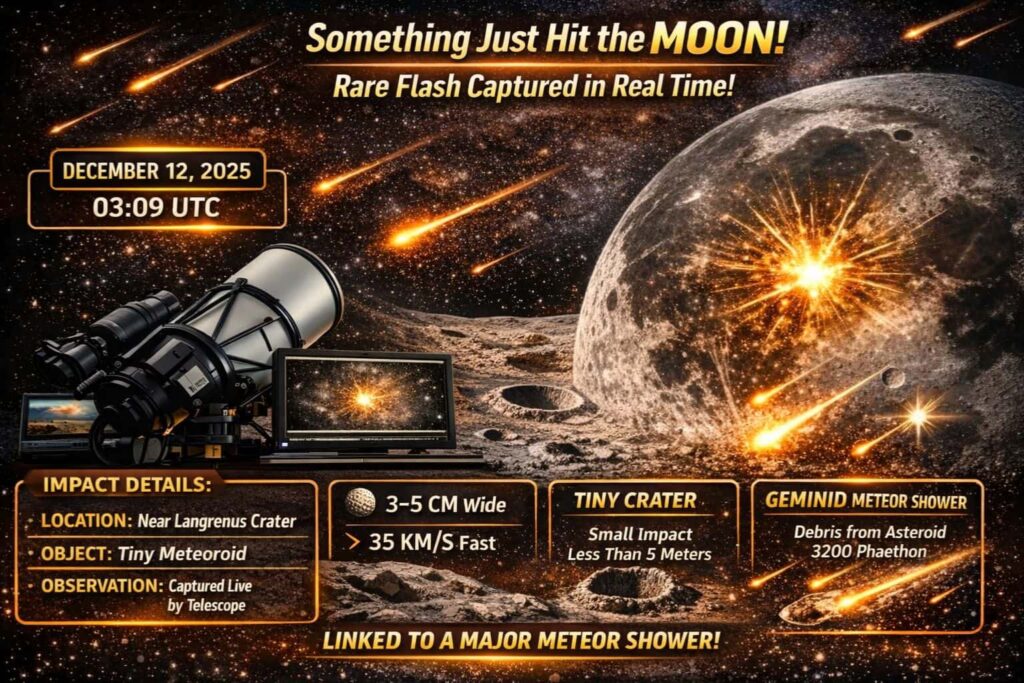
Something extraordinary happened on the Moon, and astronomers were watching at the exact moment it occurred. A fast-moving object from space slammed into the Moon’s surface and created a sudden flash of light that was recorded live through advanced telescopes. Events like this are extremely rare to witness in real time.
Most lunar impacts are discovered later, after scientists analyze long hours of recorded footage. This time, however, the bright flash was seen instantly, confirming a direct collision with the Moon while observations were still in progress.
The event has sparked major interest in the scientific community because it provides valuable data about space debris, meteor activity, and the risks faced by future lunar missions.
Astronomers Witness the Impact in Real Time
The impact occurred while astronomers were actively monitoring the Moon’s dark side using sensitive optical instruments. Suddenly, a brief but powerful flash appeared on the lunar surface, lasting less than a second.
Because the Moon does not produce flashes naturally, scientists immediately recognized this as a meteoroid impact. The real-time observation allowed researchers to confirm the event without relying on later data analysis, which is uncommon in lunar impact studies.
Live detection also reduces uncertainty. Scientists could rule out camera glitches, satellite interference, or atmospheric effects, making this observation especially reliable and scientifically valuable.
What Exactly Hit the Moon?
The object that struck the Moon was very small, likely no larger than a few centimeters. Despite its size, it was traveling at an extremely high speed — tens of kilometers per second.
At such speeds, even a tiny rock carries enormous energy. When it collided with the Moon’s surface, that energy instantly converted into heat and light, producing the visible flash recorded by astronomers.
Unlike Earth, the Moon has no atmosphere to slow down incoming space objects. This means meteoroids hit the surface at full speed, making even small impacts dramatic and detectable.
Why the Flash Was So Bright
The brightness of the flash depends on three main factors:
- The speed of the object
- The angle of impact
- The material composition of both the object and the lunar surface
When the meteoroid struck the Moon, the sudden release of energy heated the impact site to extreme temperatures in a fraction of a second. This caused the surface material to glow briefly before cooling down.
Although the flash was short, it was bright enough to be clearly detected by telescopes designed to monitor faint lunar details.
Where on the Moon Did the Impact Occur?
Based on telescope data and positional analysis, astronomers determined that the impact happened near a known lunar region close to the Moon’s edge. This area is visible during certain lunar phases, making it ideal for impact monitoring.
Finding the exact crater left behind is challenging. The object was small, and any resulting crater would be tiny — possibly only a few meters wide or less. Such craters are difficult to identify unless high-resolution images from before and after the impact are compared.
Future lunar orbiters may help confirm the precise location by scanning for fresh surface changes.
Connection to a Major Meteor Shower
The timing of the impact strongly suggests a connection to a well-known meteor shower that occurs every year in December. During this period, Earth and the Moon pass through a dense stream of cosmic debris.
While Earth’s atmosphere burns up most of these particles as meteors, the Moon offers no such protection. As a result, many fragments directly strike the lunar surface, increasing the chance of observable impacts.
This makes meteor shower periods especially important for lunar monitoring programs, as they offer more opportunities to study real collisions.
Why We See More Impacts on the Moon Than on Earth
Earth and the Moon experience similar space environments, but their surfaces tell very different stories.
Key Differences Between Earth and the Moon
- Atmosphere
Earth has a thick atmosphere that destroys most incoming objects. The Moon has none. - Surface Changes
Earth’s weather and geology erase impact marks over time. The Moon preserves craters for millions of years. - Visibility of Impacts
Lunar impacts often produce visible flashes. Earth impacts usually go unnoticed unless very large.
Because of these differences, the Moon acts like a natural record of space collisions.
Why This Event Matters to Science
Every confirmed lunar impact helps scientists better understand:
- The number of small objects moving through near-Earth space
- How often the Moon is struck by meteoroids
- The energy released during small-scale impacts
- Potential hazards for astronauts and equipment
This information is essential as space agencies plan long-term human missions to the Moon. Even tiny debris can pose serious risks to habitats, satellites, and astronauts.
Live observations provide higher-quality data than recorded discoveries, making this event especially useful for research.
What This Means for Future Moon Missions
As interest in lunar exploration grows, understanding impact risks becomes more important. Space agencies plan to build permanent structures on the Moon, including research stations and landing zones.
Knowing how often impacts occur and how powerful they can be helps engineers design safer equipment and shielding. Events like this one offer real-world examples that improve mission planning and astronaut safety.
Can We Expect More Impacts Like This?
Yes. The Moon is constantly being hit by small objects from space. Most impacts go unnoticed, but during meteor showers, the chances of visible flashes increase.
With more telescopes dedicated to lunar monitoring, scientists expect to capture more live impacts in the future. Each one adds a piece to the puzzle of how our solar system behaves today.
Frequently Asked Questions
Was the Moon damaged by the impact?
Only slightly. The impact likely created a very small crater with no long-term effect.
Could something like this hit Earth?
Objects of this size usually burn up harmlessly in Earth’s atmosphere.
Why don’t we see these flashes with the naked eye?
They are very brief and faint, requiring sensitive instruments to detect.