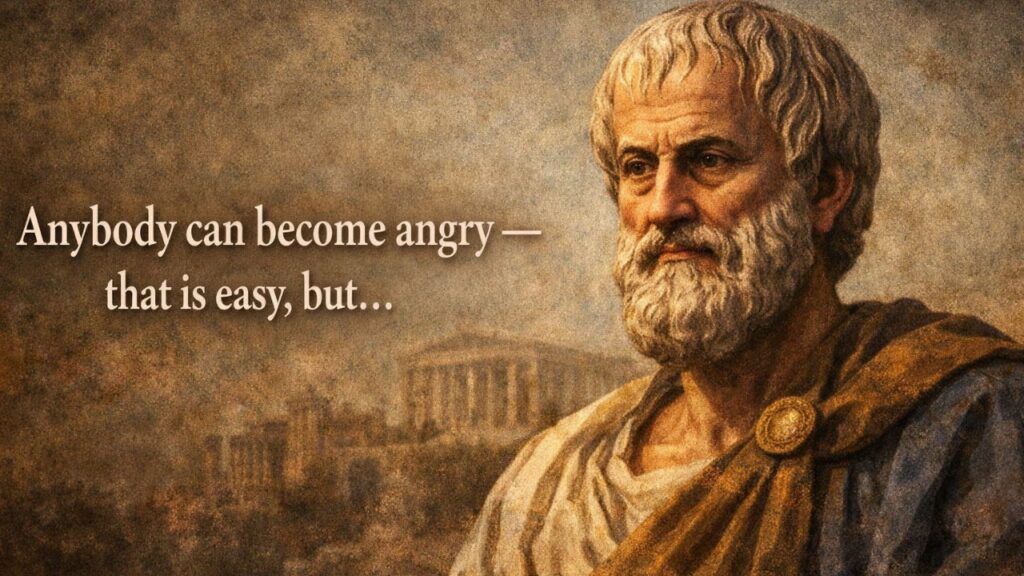
Aristotle lived from 384–322 BCE, and much of his work focused on how humans can act with virtue and reason. In Nicomachean Ethics, he classified emotions not as problems but as forces that must be guided toward balance. His well-known principle of the “Golden Mean” explains that virtue lies between deficiency and excess — and anger is one of the clearest examples.
Ancient Greek philosophy did not treat anger as inherently negative. Instead, it viewed it as a natural human response that, when controlled, could support justice, fairness, and moral courage. Aristotle defined a virtuous state of anger known as praotēs (proper gentleness/moderation), stressing that the value of anger depends on direction and proportion.
Today, modern psychological research supports Aristotle’s reasoning. Studies in emotional regulation consistently show that unmanaged anger increases risks of health problems, social conflict, and poor decision-making, while controlled anger helps assert boundaries, address injustice, and initiate positive change. This makes Aristotle’s centuries-old insight scientifically relevant even now.
The Core Idea of the Quote
“Anybody can become angry — that is easy… but doing it in the right way is difficult.”
Aristotle was not warning against anger; he was explaining that precision in emotion is what separates maturity from impulse. The quote highlights five measurable elements: the right person, degree, time, purpose, and method. These are not abstract ideas — they form a framework for rational behavior.
Anger becomes harmful when it is misdirected, exaggerated, delayed too long, or motivated by ego rather than reason. Aristotle describes anger as something that must align with ethics and rational judgment, not just instincts. In other words, anger becomes a skill, not simply a reaction.
A Structured View of Aristotle’s Anger Framework
Below is a factual comparison between Aristotle’s classical ideas and modern psychological concepts:
| Aristotle’s Condition | Meaning in His Philosophy | Modern Equivalent |
|---|---|---|
| Right Person | Anger must target the real cause, not an unrelated person | Cognitive clarity & accountability |
| Right Degree | Anger should match the seriousness of the situation | Emotional regulation intensity |
| Right Time | Expressed neither too early nor too late | Timing & impulse control |
| Right Purpose | Anger must aim at justice or correction, not revenge | Ethical motivation |
| Right Way | Expressed without cruelty or excess harm | Constructive communication |
This structure shows that Aristotle was not simply moralizing; he was outlining a practical emotional model still used in psychology, leadership training, and conflict-resolution frameworks today.
Why This Quote Still Matters in Practical Life
Modern environments produce frequent triggers — social media conflicts, workplace pressure, family responsibilities, and societal injustice. Data from behavioral studies repeatedly show that unregulated anger leads to increased stress responses, affecting the heart, immune system, and cognitive judgment. Aristotle anticipated this by insisting on emotional discipline.
In personal relationships, controlled anger helps identify problems instead of destroying trust. In workplaces, it supports accountability rather than hostility. In society, it shapes movements driven by justice rather than chaos. Every layer of modern life benefits when anger is directed intelligently rather than explosively.
Key Takeaways Explained in a Simple List
- Anger itself is not wrong; uncontrolled anger is.
- Aristotle treats anger as a skill requiring knowledge and discipline.
- The “right person, time, purpose, way, and degree” form a practical decision framework.
- Modern psychology validates Aristotle’s model through emotional regulation science.
- Balanced anger can protect values, relationships, and justice, while reckless anger harms them.
Each point above rests on factual philosophical principles and verified psychological understanding, showing continuity between ancient reasoning and modern science.
Final Reflection
Aristotle’s quote is not just a moral lesson; it is a structured guide to emotional intelligence created more than 2,300 years ago. It proves that human behavior challenges have remained consistent, and thoughtful self-control has always been essential. When anger is aligned with logic, proportion, and purpose, it becomes a tool for fairness rather than destruction.
Handled correctly, anger becomes discipline. Handled carelessly, it becomes damage. Aristotle understood this clearly — and that is why his words continue to educate the modern world in both philosophy and psychology.